The right bookshelf makes books part of everyday life. The wrong one turns them into a jumble nobody touches. Before you buy, think about three things: how old your child is, how much space you have and whether you want books cover-out or spine-out.
Cover-out or spine-out?
- Cover-out (front-facing) is best for babies, toddlers and preschoolers. They choose books by the picture on the front, not the title on the spine.
- Spine-out fits more books in less space and suits older kids who can read titles.
Option 1: Wall ledges (best for small spaces)
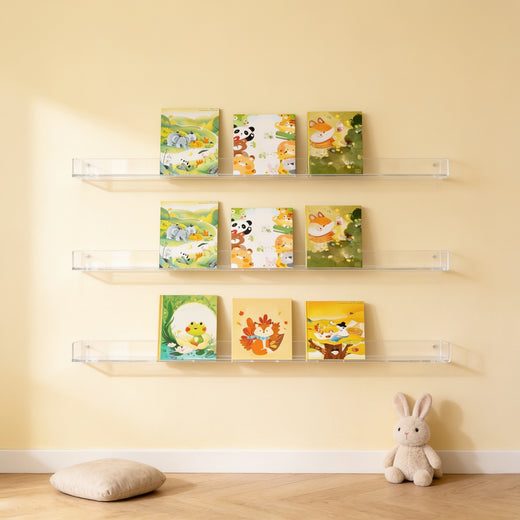
Clear ledges keep books cover-out and completely off the floor. The Aspen picture book shelves are 17.7 inches long and 1.9 inches deep, sold in packs of 1 to 3. Choose micro-nail hooks for painted or plaster walls, or adhesive for smooth surfaces like tile or wood panels. Check that your thickest board books fit the 1.9-inch trough, and mount them away from the crib and changing table.
Good for: nurseries, small rooms and above a reading chair.
Option 2: A low sling rack (best for toddlers)
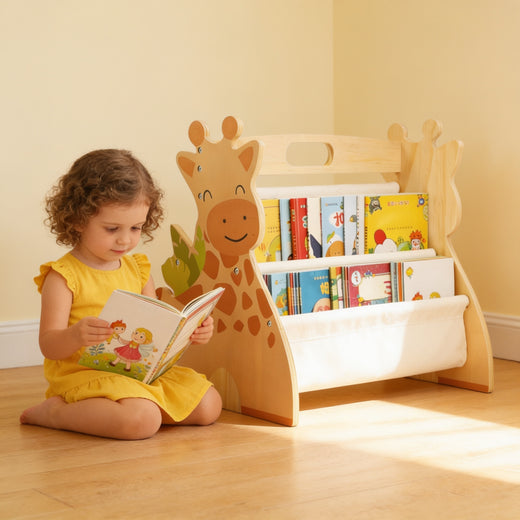
Fabric sling racks hold books cover-out at a toddler's height. The Alder book rack is under 14 inches tall, with two sling tiers on each side, in giraffe, dinosaur, unicorn or bear designs. Load both sides evenly and keep it on a flat floor.
Good for: toddlers choosing books by themselves, Montessori-style rooms.
Option 3: A bookshelf with toy storage (best all-rounder)
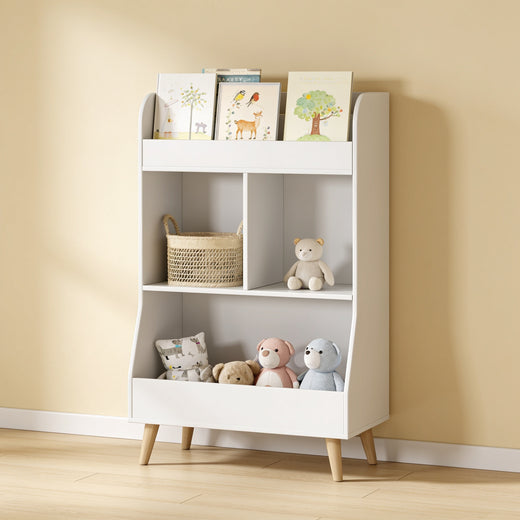
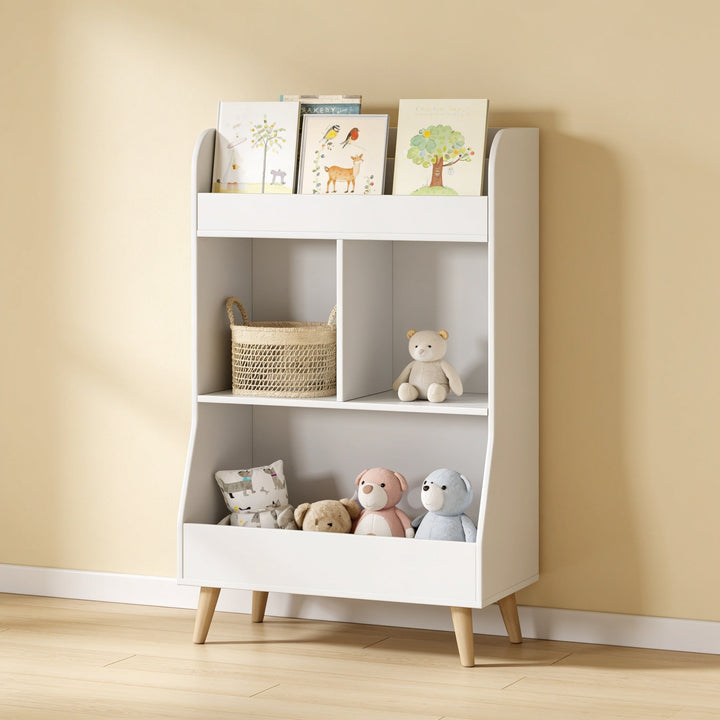
If books and toys share a room, one piece can hold both. The Elm bookshelf is 24.4 inches wide and 36.8 inches tall, with a two-tier front-facing book rack on top, two cubbies and a deep toy bin at the bottom. It holds up to 110 pounds in total and must be anchored with the included anti-tip device.
Good for: kids rooms and playrooms that need books and toys together.
Option 4: A reading nook bookshelf (best for a special spot)
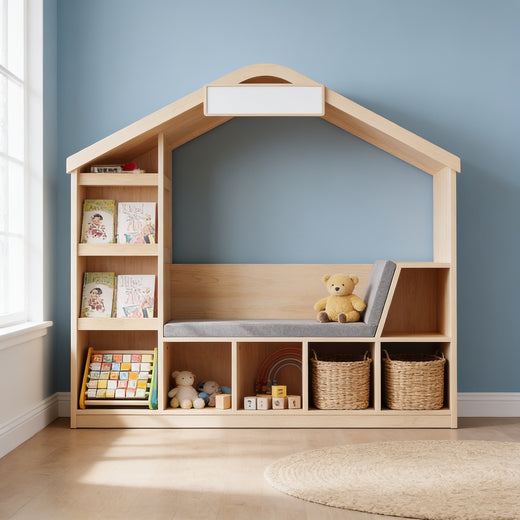
A bookshelf with a built-in seat gives kids a cozy corner of their own. The Birch (natural wood) and Hazel (white, water-resistant finish) are both 47.2 inches wide and 55.1 inches tall, with a three-tier front-facing book display, five 11 by 11 inch cubbies and a cushioned bench inside a house-shaped frame. Hazel's cushion cover is machine washable, and Birch's foam cushion is removable and washable. Both are designed for ages 2 to 8 and come with an anti-tip wall anchor kit.
Good for: a reading corner that grows with your child. See reading nook ideas.
Option 5: A big book-and-toy wall (best for large collections)
The Maple toy storage and book display is 55.3 inches wide, with a front-facing wave shelf for books alongside nine bins, two fabric drawers and a rolling toy chest. The frame is solid pine. Anchor it with the included anti-tip hardware.
Option 6: A small spine-out desk rack (best for older kids)
The Sunny book rack holds a small stack of books spine-out in a V-shaped cradle, like a mini bookshelf, with a 12.6-inch footprint. It's ideal on a desk or low shelf for kids who can read titles.
Safety checklist
- Anchor every bookshelf that could tip, even low ones, with the included hardware.
- Put heavy books on the lowest shelves.
- Teach kids not to climb shelves.
- Keep wall shelves away from the crib and changing area.
More in how to anchor furniture to the wall.
Questions parents ask
What kind of bookshelf is best for toddlers?
A low, front-facing one, so they can see covers and choose books themselves.
How many books should a kids bookshelf hold?
For toddlers, 10 to 15 books out at a time is plenty. Rotate the rest.
Do kids bookshelves need to be anchored?
Yes, anything that could tip. Use the anti-tip hardware that comes with it.
More tips in how to organize kids' books.