A nursing pillow raises your baby to the right height for feeding, so you're not hunched over or holding their full weight for every feed. Used well, it can save your back, neck and arms. Here's how to set one up, plus the safety rules that matter most.
Before first use
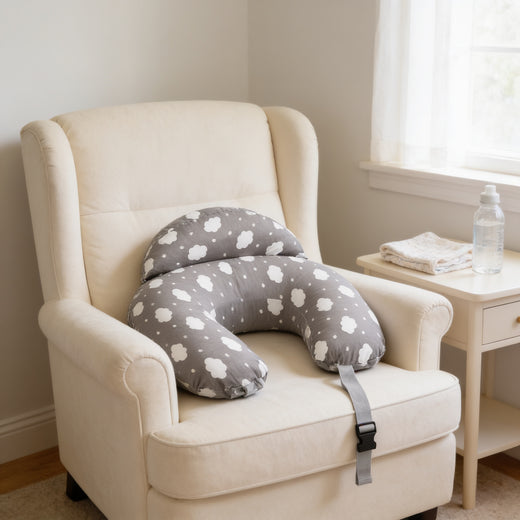
Many nursing pillows arrive compressed. Ours needs a little patience: pat the nursing pillow and give it 48 to 72 hours to expand fully before the first feed.
How to set it up
- Sit comfortably with your back supported and your feet flat or on a footstool.
- Put the pillow around your waist. Ours has an adjustable strap that buckles around your waist, so it stays put when you shift position. Snug it so there's no gap between you and the pillow.
- Bring baby up to you, not you down to baby. The pillow should hold your baby at breast or bottle height.
- Relax your shoulders. If you're leaning forward, add a cushion behind your back or under your arm.
The raised top cushion on ours adds a little extra height, which helps if you're tall or your baby is very small.
Common positions
- Cradle hold: baby lies across the pillow, tummy to tummy with you, head in the crook of your arm.
- Cross-cradle hold: similar, but you support baby's head with the opposite hand. Many parents find this helpful in the early days.
- Football hold: baby lies along your side on the pillow, feet toward your back. Often comfortable after a C-section.
If feeding hurts or your baby struggles to latch, ask your pediatrician or a lactation consultant for help.
Bottle feeding too
A nursing pillow works for bottle feeds as well, and a partner can use it just as easily. Keep baby semi-upright and the bottle tilted so the nipple stays full of milk.
The safety rules
This part matters most. A nursing pillow is for awake, supervised feeding only.
- Never use it for sleep or lounging.
- Never put it in a crib, bassinet or play yard.
- The strap goes around your waist only, never around your baby.
- If your baby dozes off, move them to a firm, flat sleep space on their back.
Babies can slip into positions on soft, curved surfaces that make it hard to breathe, which is why these rules matter so much.
Caring for it
The cover on ours isn't removable or machine washable, so spot clean it with a damp cloth. A burp cloth over the top during feeds catches most spills.
Questions parents ask
Do I need a nursing pillow?
Not strictly, but many parents find it saves their back and arms, especially in the early weeks.
Can my baby nap on a nursing pillow?
No. It's for awake, supervised feeding only. Move a sleepy baby to a firm, flat sleep space.
How long will I use a nursing pillow?
Ours is designed for feeding babies from 0 to 12 months. Many parents use one most in the first few months.
More in breastfeeding essentials and how to breastfeed in public.